UNDER CONSTRUCTION

DENVER’S RESTAURANTS ARE IN CRISIS. THE DATA IS CLEAR. IT’S TIME FOR CITY COUNCIL TO ACT.

KEEP RESTAURANTS OPEN

PROTECT RESTAURANT JOBS

STRENGTHEN OUR NEIGHBORHOODS

PROTECT TIP INCOME

KEEP RESTAURANTS OPEN ✴ PROTECT RESTAURANT JOBS ✴ STRENGTHEN OUR NEIGHBORHOODS ✴ PROTECT TIP INCOME ✴

DENVER’S RESTAURANT CRISIS

A landmark 2025 report from Visit Denver and Denver Economic Development & Opportunity confirms what restaurant operators have been saying for years: Denver’s restaurant industry is facing a structural crisis—not a temporary downturn.

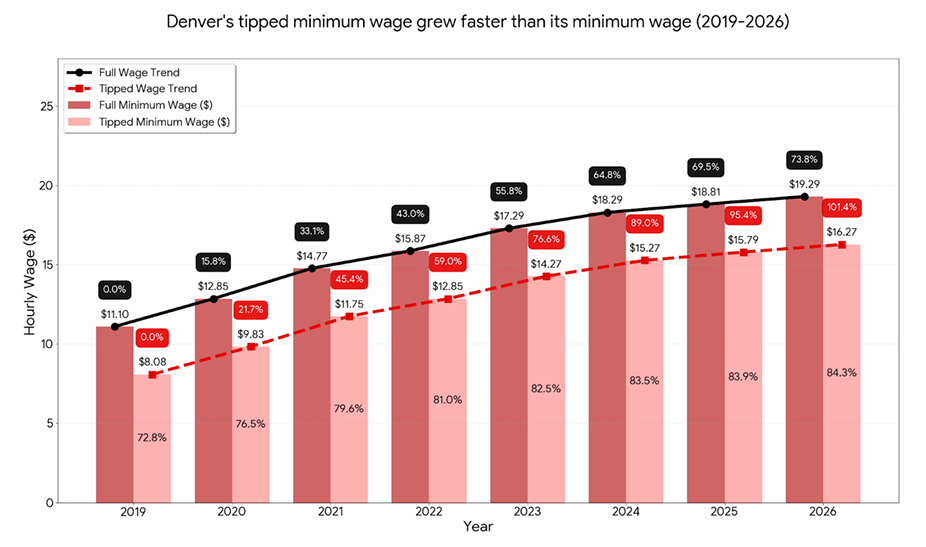
Labor costs have increased 50–55% since 2019. Denver’s tipped minimum wage has risen 95% in five years—faster than any comparable city. Earnings have fallen 20% even as restaurants have raised menu prices 28%. It’s now more expensive to operate a restaurant in Denver than in New York City.

The result: thousands of lost jobs, shuttered neighborhood restaurants, and commercial corridors that once defined Denver now described as “dying.”

WHAT’S AT STAKE

Denver’s restaurant industry isn’t experiencing a temporary downturn. It’s undergoing a structural contraction driven by costs that are rising faster than any restaurant can absorb.

Denver’s restaurant industry isn’t experiencing a temporary downturn. It’s undergoing a structural contraction driven by costs that are rising faster than any restaurant can absorb.

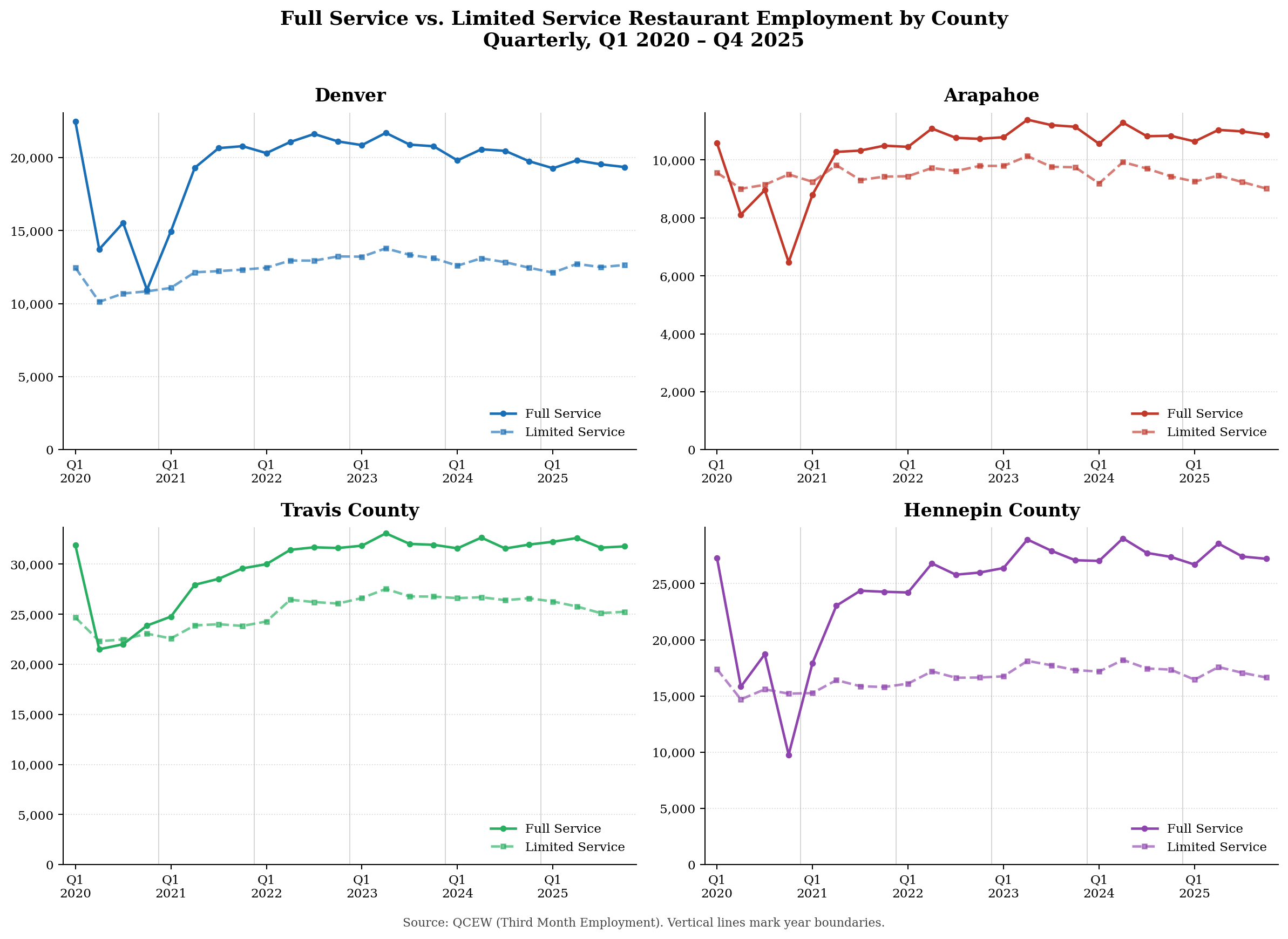
Between 2019 and 2024, Denver lost approximately 6% of its overall restaurant jobs and 15% of its full-service restaurant jobs. The rest of Colorado saw food service employment grow by 3.3% during the same period. Denver is missing an estimated 10,000–15,000 restaurant jobs that would have existed if the sector had followed its pre-2020 growth trajectory.

Denver has lost 22% of its restaurants over the past three years, as reported by theDenver Post.

Restaurants employ nearly 8% of Denver’s workforce and generate approximately 13% of the city’s sales tax revenue. When restaurants close, it’s not just business owners who lose; it’s workers, neighborhoods, and the city’s bottom line.

Denver is not alone in grappling with these challenges. Cities across the country — including Chicago, Washington, D.C., and others — are working through the same tension between rising minimum wages and restaurant sustainability. But Denver's situation is uniquely urgent: our minimum wage is higher than all of them, while our tip credit is among the smallest in the nation.

UNDERSTANDING THE TIP CREDIT

The tip credit is one of the most misunderstood policies in the restaurant industry. Here’s what matters: no restaurant employee in Colorado can be paid less than the full minimum wage. The tip credit affects how much the restaurant pays toward total income, including tips—not whether workers receive it.


Denver’s tipped minimum wage is now the 8th highest in the country, and it has increased more than twice as fast as the overall minimum wage since 2019.

Source: 2024 National Restaurant Association data based on U.S. Census data

WHAT’S THE PROBLEM?

The fixed tip offset of $3.02 in the state constitution means that Colorado restaurants are paying a rapidly increasing percentage of their tipped employees’ wages, which is leading to job cuts, lost hours, and restaurant closures.

Of the 28 U.S. states and cities that allow restaurants to use a tip credit, Denver and Boulder have the highest tipped wages in the country.

WHAT DOES THIS MEAN FOR RESTAURANT WORKERS?

This amended bill will NOT decrease wages in any part of Colorado.

It will protect the tip credit and tipping in general, which tipped workers overwhelmingly love and rely on for the great pay they expect from their restaurant jobs.

RECENT NEWS